Showing posts with label parliament. Show all posts

Wednesday, December 29, 2010

Post-Vote, Declined Mandates Reshaped Kyrgyzstan’s Legislature

Reposted from Eurasianet.org
by Ryan Weber

Did Kyrgyzstan’s voters get the leaders they chose?

On December 17, the Respublika party announced the successful formation of a new governing coalition to lead Kyrgyzstan’s parliament. This second attempt at forming a majority succeeded where the first failed because Respublika, which led the effort, is unattached to the North/South regional divide or pro-/anti-government legacy of the other four winning parties.

But Respublika is unlike Kyrgyzstan’s other political parties in another way as well -- by the time the party came to power, most of its minorities and women had declined their seats in parliament, leaving a 100 percent ethnic Kyrgyz and mostly male party.

According to the Kyrgyz electoral code, voters cast ballots for a party’s list of candidates. Based on votes, each party is awarded a certain number of seats that go to the top candidates on their respective party lists. If a candidate declines his “mandate,” then the seat passes to the next highest candidate on his party’s list.

One candidate from Ata-Meken, Joomart Oturbayev, declined his mandate despite being #3 on the party’s list. There are rumors that Ata-Jurt co-chairman Kamchybek Tashiev wanted Dinara Isaeva, wife of former Prime Minister Daniyar Usenov (who is in hiding) and #12 on the Ata-Jurt party list, to decline hers, but she refused. Ata-Jurt, Ar-Namys, and the Social Democrats (SDPK) have not had a single candidate refuse a mandate.

Respublika, on the other hand, has had an incredible 18 mandates -- of its 23 total -- refused by candidates in the party’s top positions.

The combined effect of these voluntary exclusions has been to make Respublika’s parliamentary delegation much less diverse than its original party list -- the list voters elected. Alevtina Zavgorodnyaya (#8) and Yuri Nizovskii (#27), both ethnic Russians, were the only non-Kyrgyz candidates within Respublika’s top 50 positions. After they both declined their mandates, Respublika became the only party in parliament not to have a single non-Kyrgyz delegate. Four women candidates declined to enter parliament for Respublika, though five remained.

The resulting Respublika faction in parliament is exclusively Kyrgyz and 78 percent male -- i.e. not very representative of Kyrgyzstan as a whole.

Tuesday, December 28, 2010

No Thank You: Many Respublika Candidates Refused Mandates

by Ryan Weber

Though not yet much reported, something odd took place in the 2010 Kyrgyz Parliamentary elections. It occurred after all the votes were tabulated, but before the new MPs were sworn in.

It wasn't fraud per se, nor was it at all illegal. Instead, it was the unusual expansion of a common, but usually isolated, practice of elected party candidates declining to accept a seat in parliament (their "mandate") on behalf of their party.

But this time, candidates from the Respublika party exercised their right to decline the mandates at an incredible rate.

Further analysis will be posted soon, but for now, here is the data which was compiled from Resublika's published election-day party listand the final list of sworn MPs issued by the Central Election Committee (CEC).

Party List #, Name, Ethnicity, Mandate Decision
  1. Babanov, Omurbek - Kyrgyz - Accepted, MP#1
  2. Alimbekov, Nurbek - Kyrgyz - Accepted, MP#2
  3. Pirmatov, Ishaq - Kyrgyz - Accepted, MP#3
  4. Sultanbekova, Cholpon - Kyrgyz - Accepted, MP#4
  5. Isaev, Kanatbek - Kyrgyz - Accepted, MP#5
  6. Torobaev, Bakyt - Kyrgyz - Accepted, MP#6
  7. Sulaimanov, Altynbek - Kyrgyz - Accepted, MP#7
  8. Zavgorodnyaya, Alevtina - Russian - DECLINED
  9. Moldobaev, Askhat - Kyrgyz - DECLINED
  10. Baatyrbekov, Almazbek - Kyrgyz - Accepted, MP#8
  11. Esenamanov, Zamirbek - Kyrgyz - DECLINED
  12. Aknazarova, Rosa - Kyrgyz - Accepted, MP#9
  13. Boko, Kenjebek - Kyrgyz - Accepted, MP#10
  14. Aripov, Nazarali - Kyrgyz - Accepted, MP#11
  15. Turuskulov, Jyrgalbek - Kyrgyz - DECLINED
  16. Djumaliev, Elmira - Kyrgyz - Accepted, MP#12
  17. Obdunov, Elmurat - Kyrgyz - Accepted, MP#13
  18. Kadyrkulov, Iskender - Kyrgyz - DECLINED
  19. Osmonov, Malik - Kyrgyz - Accepted, MP#14
  20. Amanbaeva, Urulkan - Kyrgyz - Accepted, MP#15
  21. Arym, Kubat - Kyrgyz - DECLINED
  22. Aitmatov, Kushtarbek - Kyrgyz - Accepted, MP#16
  23. Shaynazarov, Tynchtyk - Kyrgyz - Accepted, MP#17
  24. Omurbekova, Altynai - Kyrgyz - Accepted, MP#18
  25. Andash, Turatbek - Kyrgyz - DECLINED
  26. Ismailov, Ulanbek - Kyrgyz - DECLINED
  27. Nizovskii, Yuri - Russian - DECLINED
  28. Shayymkulova, Ainura - Kyrgyz - DECLINED
  29. Jolbolduev, Pamirbek - Kyrgyz - DECLINED
  30. Bakirov, Mirlan - Kyrgyz - Accepted, MP#19
  31. Oskonbaev, Beyshenbek - Kyrgyz - DECLINED
  32. Alimzhanova, Damir - Kyrgyz - DECLINED
  33. Asylbek, uulu Damirbek - Kyrgyz - DECLINED
  34. Duyshenbiev, Nursultan - Kyrgyz - DECLINED
  35. Murashev, Nurbek - Kyrgyz - Accepted, MP#20
  36. Dzhumabekova, Akylsayra - Kyrgyz - DECLINED
  37. Bekmatov, Abdyjapar - Kyrgyz - Accepted, MP#21
  38. Zakirov, Asylbek - Kyrgyz - DECLINED
  39. Sabirov, Maksat - Kyrgyz - Accepted, MP#22
  40. Sagynbaeva, Gulifa - Kyrgyz - DECLINED
  41. Rezhavaliev, Abdulatipov - Kyrgyz - Accepted, MP#23

Thursday, December 23, 2010

Skin & Bones: The Structure of the new Kyrgyz Parliament


by Ryan Weber

"It's fun to write about an ACTUAL Kyrgyz government instead of a hypothetical one."
-Jax Jacobsen, reporter for Central Asia Newswire, in a tweet on December 20th, 2010

With the December 17 announcement of a successful majority coalition agreement, the Kyrgyz Jogorku Kenesh parliament can finally get to the business of governing the Republic after more than 2 months of political stalemate. Following the results of the October 10 elections, 5 parties entered the 120-seat parliament, all far short of the 60 seats necessary to appoint a Prime Minister and other top positions. Ata-Jurt, the largest party, controlled just 28 seats, while Ata-Meken was the smallest with 18.

The successful coalition - even more impressive following the instantaneous collapse of the first such effort led by the Social Democrats (SDPK) - was undertaken by the Respublika party, and included 'pro-grovernment' SDPK as well as the nationalist-tinged Ata-Jurt.

Ata-Meken and Ar-Namys went into the opposition, but are unlikely to caucasus given their radically different positions on domestic and foreign policy. The same could be said of the relationship between SDPK and Ata-Jurt, though the coalition agreement suggests they may have found ways to compromise.

In rapid succession, the new coalition was able to fulfill its mandate by electing the new government's top leadership. Almazbek Atambaev of SDPK becomes Prime Minister (92 votes), Omurbek Babanov of Respublika becomes Deputy Prime Minister (88 votes), and Akhmat Khelidbekov of Ata-Jurt becomes Speaker of Parliament (101 votes).

All three positions are newly-empowered by the 2010 Kyrgyz Constitution, which elevates Parliamentary executives over the Kyrgyz President for the first time in the country's 20 years of independence.

Wednesday, December 22, 2010

Putting on a Show: Friends, Enemies & 'Frenemies' in Kyrgyz Politics

December 20, 2010, Bishkek – 24.kg News Agency
written by Asel Otorbayeva
style edit by Ryan Weber


Once again, Kyrgyz politicians place the importance of assigning government positions over actual governing.


Old Political Enemies

In its second attempt, the Kyrgyz parliament finally succeeded in electing a speaker. Their choice was the leader of the party [Ata-Jurt] which previously called for the return of ousted President Bakiev [actually, a rumor], and is comprised of many former allies to the fallen President.

Opponents [of Ata-Jurt] were highly critical of its intentions in the run-up to Parliamentary elections in October, charging it with a variety of "sins." Some even suggested members of Ata-Jurt helped instigate the June riots in Osh the ignited ethnic tension [and in several ways increased Ata-Jurts Nationalist rhetoric going into the election]. But the accusations against Ata-Jurt were never proven, and the other parties dropped attempts to link Ata-Jurt with the violence. Being veteran politicians, rather than defend themselves, Ata-Jurt enlisted [Kyrgyz] victims of the June events to protect their reputation.

Relatives of those killed during the April coup that removed Bakiev responded passionately to the former Bakiev administrators, [throwing eggs and] attempting to block their admittance to the new parliament. They demanded that such politicians never participate in government again, but the other ["pro-government"] parties did nothing to block their participation [such as passing a controversial Lustration law]. After a while, the general public acquiesced. [Respublika] party - as if it had forgotten the public distaste for Ata-Jurt - instructed the Social Democrat party (SDPK) to "make friends" with Ata-Jurt. They explained that economic concerns must trump personal animosity.

Now Almazbek Atambayev, SDPK leader and [recently-elected] Prime Minister must find a way to work with Akhmatbek Kelidbekov - the new Speaker of Parliament from Ata-Jurt. Whether they want to or not, their cooperation is vital for any progress [in Kyrgyzstan].

Friday, December 17, 2010

Take Two: Kyrgyzstan Finally Has New Government

Newly-elected Kyrgyz Prime Minister Almazbek Atambaev (at center) joined by Omurbek Babanov (sans tie) and other members of the successful majority coalition that finally gave Kyrgyzstan a functional government on December 17. (photo credit S. Dosalieva, AKI Press)

Three of Kyrgyzstan’s quarreling parties have finally succeeded – after two months and one failed attempt – to form a government. The partnership may seem an unlikely one, but it unifies the country’s fractious north and southand all hopes are on this group to shepherd the country safely into a new year without political instability and violence.
Parliament convened on December 17 to approve the coalition proposed by Respublika leader Omurbek Babanov. Provisional President Roza Otunbayeva chose Babanov to lead the process on December 4, after the first attempt by her Social Democratic Party’s (SDPK) Almazbek Atambayev, fell through.

This coalition looks much like the first, botched one, with a stark exception. In place of the pro-Otunbayeva Ata-Meken party, it includes the nationalist Ata-Jurt party, whose Myktybek Abdyldayev will take the speaker position; Atambayev has assumed the premiership. Together with Respublika, the coalition holds 77 of the legislature’s 120 seats, a comfortable majority.

Tuesday, December 14, 2010

Who Will Become Author of Kyrgyz Political Default?

Reposted from News Agency 24.kg
Bishkek - December 14, 2010
(0913 hrs)
written by Asel Otorbayeva
style edit by Ryan Weber


In the throes of giving birth to a parliamentary majority coalition, Kyrgyzstan may suffer a second miscarriage. The reason is obvious - excessive greed [by party leaders] for key positions in the future parliament.


Which Prime Minister is Best?

The main battle area among the five parties appears to be for the top spot [in the restructured Kyrgyz] government. Leaders of Social Democratic Party of Kyrgyzstan (SDPK) and Ar-Namys party both want to become Prime Minister. For better or worse, neither are strangers to the political arena - each possessing ample experience as well as political baggage. And neither leader, Almazbek Atambayev of SDPK or Felix Kulov of Ar-Namys, show any sign of willingly stepping aside.

The Respublika party was chosen for the second mandate to form a majority coalition, and its leader, Omurbek Babanov, now faces one of the most difficult challenges of his career. Much younger than the other party leaders, and with less time in politics, he is finding it difficult to compete. His most persuasive arguments are unable to overcome the [entrenched] SDPK or the "iron shield" of Ar-Namys. It is no secret that ambitions for the Prime Minister position are entwined with hopes for the 2011 Presidential election. SDPK and Ar-Namys both aspire to the presidency, and controlling the Prime Minister may be a necessary 'trump card' for that effort.


Speaker’s Throne as Alternative

[Realizing that the new Kyrgyz Constitution dramatically increases the power of parliament, the position of Speaker of Parliament has become much more valuable. Now, not only the leader of the Ata-Meken party, [Omurbek Tekebaev] aspires to the post [he once held], but also members of Respublika, Ar-Namys, and Ata-Zhurt's co-chairman, Akhmatbek Kelidbekov.

According to the Constitution, which Tekebaev authored, tremendous authority resides in the hands of the Speaker. Deputies of the fifth convocation - the current parliament - seem unaware of the trap inherent in Tekebaev's government structure. He "planted a bomb with a clock mechanism continuously ticking like a reminder: the Prime Minister and the Speaker shall, as Siamese twins, breathe, sleep and most importantly - work in unison. Otherwise - [say] goodbye to the coalition, and hello [to the] dissolution of parliament!"

Assuming Felix Kulov steps aside, and his sworn [enemy] Atambaev becomes Prime Minister. How well can Atambaev work with [Speaker] Kelidbekov? Will this arrangement have a [viable] future? Of course not. And what about another combination - Speaker Kulov and Prime Minister Atambaev?

Whatever the experts say about the necessity or political wisdom of regional balance [i.e. the inclusion of Ata-Jurt as a "Southern" party along with the other, predominantly "Northern" factions] to the long-term stability of state, most of the existing coalitions are [destined to be] short-lived.

Monday, December 13, 2010

Waiting for Parliament and a Kyrgyz Santa Claus

by Ryan Weber

For those of us anxiously waiting to see what sort of governing coalition will emerge from the Kyrgyz parliamentary negotiations, it's beginning to feel more and more like we may be waiting for a 'Godot' - the fictional character in Samuel Beckett's drama who, (in)famously, never arrives. Or perhaps, with the December 24 deadline for the formation of the next parliamentary coalition, it's up to the equally-fictional Santa Claus to finally bring resolution to the Kyrgyz political situation.

After requiring the full 15 working day period allowed by the constitution, the SDPK-Respublika-AtaMeken coalition failed to elect Omurbek Tekebaev as Speaker of Parliament on December 2. Since the coalition agreement was based on the awarding of the Speaker position to Tekebaev, as well as the Prime Ministership to SDPK leader Almazbek Atambaev, and Deputy PM to Respublika's Omurbek Babanov, the coalition couldn't enforce its contract, and thus dissolved. With 67 nominal coalition members in the 120-seat legislature, the surprising defeat with just 58 votes for Tekebaev demonstrated the practical, as well as theoretical, shortcomings of the agreement. Just days after signing a pact of solidarity, coalition members voted against their own coalition.

On December 3, an embarrassed Atambaev asked Kyrgyz President Roza Otunbayeva to select another party to form the coalition. Originally, Otunbayeva said Ata-Meken, as the other "pro-government" party, would be tasked with the duty if SDPK failed. Instead, whether because Tekebaev declined the opportunity, or Otunbayeva reacted to his apparent unpopularity, Omurbek Babanov and Respublika were given the charge along with a new deadline - December 24.

With the race to form a coalition once again wide open - with rumors that perhaps 4, or even all 5 political parties will join together - the possible make up of the ruling Kyrgyz government remains an item of intense, if largely uninformed, speculation.

Monday, December 6, 2010

If at First you Don't Succeed: Kyrgyz Parliament Takes Another Shot at Forming Majority Coalition

by Ryan Weber

The march of Kyrgyzstan's fledgling parliamentary democracy took another hit on December 4 as the recently-announced "Coalition for the Sake of Stability" turned out to be a "Stillborn Coalition" as it failed to achieve its first test of forming a parliamentary government.

Despite its 3 parties controlling 67 delegates - a majority of the 120-seat Jogorku Kenesh parliament - it was only able to muster 58 votes in support of its candidate for Speaker of Parliament. That candidate, the leader of the Ata-Meken party and a former Speaker of Parliament, Omurbek Tekebaev (pictured below right), failed to receive the necessary 61 votes because 9 coalition MPs (identities unknown) didn't vote for him.

Tekebaev has been out of government positions since 2006, but remains a major player in Kyrgyz politics as a former opposition activist, interim deputy chaiman, and architect of the new Kyrgyz Constitution adopted in July. With the possible exception of President Roza Otunbayeva, he is the individual most responsible for adoption of the strong parliamentary system under which Kyrgyzstan is struggling to operate.

Wednesday, December 1, 2010

Cutting the Deck: Expert Opinions Divided on Prospects for New Coalition in Kyrgyz Parliament

by Ryan Weber

On November 29, three parties in the Kyrgyz parliament announced that they had successfully carried out President Roza Otunbayeva's directive to form a coalition of more than 60 seats. the Social Democrats (SDPK), Respublika, and Ata-Meken (Fatherland) will lead the legislature and nominate officers for the country's first ruling multi-party parliament, the 120-seat Jogorku Kenesh.

Since the announcement, various experts and analysts (including this one) have weighed in on the prospects for the coalition amidst an abysmal economy and the onset of Kyrgystan's harsh winter and regular power shortages. With Hilary Clinton's first visit to Bishkek scheduled for tomorrow (Dec 2), it's worth considering two well-respected, and entirely contrary, opinions from Bishkek-based experts.

Mars Sariev, a veteran political analyst based in Bishkek, told New Agency 24.kg that the SDPK-Respublika-AtaMeken coalition was the "best option for further development of Kyrgyzstan."
"The country is on the verge of economic and political collapse, and the ruling coalition will need team spirit. They won’t be able to cooperate without it. If we consider that each of the leaders will get their previous positions – Omurbek Tekebayev will become a Speaker, Almazbek Atambayev - Prime Minister and Omurbek Babanov - Deputy Prime Minister. In addition, recent incidents – arrest of an extremist group in the city of Osh and the explosion in the capital - had a sobering effect on the party leaders. All the incidents that broke out in the country after the April events and last outbreaks – the awareness that the state could collapse overnight and they will lose everything - joined the former oppositionists. The coalition, which could not be formed for a long time, had been established overnight. This means the coalition has a potential and contradictions between them have been minimized."

On the other hand, Elmira Nogoybaeva, head of the Bishkek-based think tank Polis Asia, told 24.kg that the resulting coalition is worrisome because it "doesn't represent interests of the people of Kyrgyzstan to the full extent."
“It turns out that interests of the south won’t be taken into account in the parliament [because the three parties in the coalition are all seen as Northerners]. I think it were more challenging to create the coalition with participation of two northern and one southern party – Ata-Zhurt. Yes, many understand these parties are ideologic and political rivals but the level of the compromise would be higher… Such coalition would be more stable. Unfortunately, the artificial regionalism intensified after [the] April events. This is dangerous. I think politicians must follow regional balance when they will distribute the portfolios."

The caveat virtually every Kyrgyz expert has used is that whatever the new coalition does, or does not, accomplish, it is operating in a situation in which "the deck is stacked against it," and "the stakes are high" for its potential democratic future.

Gambling metaphors aside, the prospects for the "experiment in parliamentary democracy" are uncertain, as is the degree to which the success or failure of the new coalition will determine the greater course of the country's governance. While it is interesting, and occasionally informative, for experts to speculate on such trajectories, the best analysis always comes in hindsight.

Fortune telling is best left to the demonstrably clairvoyant.

And tarot cards.

Kyrgyz Parliament Sets Majority Coalition

The Kyrgyz Parliament in their first (and so far, only) session on November 10. With the formation of a majority coalition on November 30, parliament is expected to begin regular meetings soon. (photo credit AFP)

by Ryan Weber

As reported earlier (Nov. 24 and Nov. 29), the Kyrgyz Parliament has been deadlocked since its opening session on November 10 because no single party, or even group of two parties, controls enough seats to form a majority of the 120-member Jogorku Kenesh Parliament and name a Prime Minister, as required by the Constitution.

On November 30, just 2 days before the deadline set by President Roza Otunbayeva, that deadlock has finally been broken. After weeks of intense negotiations, including meetings with the rival Ata-Jurt and Ar-Namys parties, the SDPK party revealed an agreement with longtime fellow "pro-government" socialist party Ata-Meken and the new business-oriented party, Respublika.

This was the exact coalition that analysts expected to emerge following the October 10 elections, but breakdowns in the negotiations, accusations of international bias, and stubborn party leaders caused the "obvious" coalition to stall time and time again. Just November 29, Farid Niyazov, spokesman for the SDPK party, said that the two most likely coalition outcomes would include the Ata-Jurt party, which controls 28 seats in parliament, the most of any party.

But on November 30, an agreement was signed - without Ata-Jurt.


Tuesday, November 30, 2010

Minority Representation Paltry in Kyrgyzstan’s New Parliament

Originally published by EurasiaNet.org
November 29, 2010 - 11:54pm, by Ryan Weber

Kyrgyzstan's October parliamentary elections have been widely acknowledged as fair and credible by local and international observers. But one issue, minority inclusion, suffered a setback which may prove especially difficult to address in the wake of June’s ethnically fueled violence. Just a handful of deputies in the Jogorku Kenesh parliament come from non-Kyrgyz ethnic groups, in large contrast to Kyrgyzstan’s 30 percent minority population.

Uzbeks are the largest minority group in Kyrgyzstan, making up 14.5 percent of the population according to 2009 estimates. But the new parliament will include only three Uzbeks among its 120 members – a mere 2.5 percent of the governing body. Local sources reacting immediately after the election predicted as many as eight Russians would take up seats, though at least two (Yuri Nizovski and Alevtina Zavgorodnyaya of Respublika) have since declined their mandates. This still leaves Russians, who account for 8.3 percent of the population, in control of twice as many seats as Uzbeks.

These developments occurred despite institutional rules designed to promote minority involvement in parliament. Article 72 of the Kyrgyz Electoral Code requires 15 percent of each party’s candidates be non-Kyrgyz. However, the code provides no guidance on dividing those spots among different ethnic groups, nor regulating where they are placed numerically on the party lists. In its preliminary report, the OSCE’s ODIHR mission cautioned that only 3.6 percent of all candidates were Uzbek, and that they and other minority candidates were often relegated to the bottom of party lists. In this capacity, they fulfilled the official quota, but were unlikely to become parliamentary delegates as no party could legally win more than 65 seats.

As parliamentary mandates were awarded, it became clear that this is exactly what happened. The most egregious example is the Respublika party, in which 11 of its 24 minority candidates were listed in spots 100 - 120.

However, 2010 did provide at least one breakthrough in minority representation. Ravshanbek Sabirov, of the Ata-Meken (Fatherland) party, became the first ethnic Tajik to serve in the Kyrgyz parliament. The successful Uzbek delegates are Anvar Artykov of Ar-Namys (Dignity), and Sabir Atadjanov and Bakhtiar Kadyrov of the Social Democrats (SDPK). There is also one deputy from the minority Korean ethnic group, Roman Shin, who has been a Member of Parliament since 2005, and now sits as a member of Ata-Jurt (Fatherland).

Wednesday, November 24, 2010

The Great (Guessing) Game: Imagining the Unlikely Kyrgyz Parliamentary Coalition

Almazbek Atambaev and Omurbek Tekebaev, shown here during the 2009 Presidential election when both were protesting incumbent Kurmanbek Bakiev's victory.  The two now face a new challenge trying to form a coalition government between their SDPK and Ata-Meken parties. (photo from AKIpress)PHOTO: Almazbek Atambaev and Omurbek Tekebaev, shown here during the 2009 Presidential election when both were protesting incumbent Kurmanbek Bakiev's victory. The two now face a new challenge trying to form a coalition government between their SDPK and Ata-Meken parties. (courtesy AKIpress)

by Ryan Weber

Since the Kyrgyz CEC announced its official vote tally, and the resulting number of seats awarded to each of the 5 parties, on November 10, politicians and analysts have been predicting what the eventual ruling coalition would look like. Initial speculation that the pro-government Social Democrats (SDPK) would caucasus with Ata-Meken to form a majority were premature; even together the two parties don't control the 60 seats required to hold majority, and divisions and delays have continued to plague negotiations.

Instead, almost out-of-the-gate, SDPK announced a coalition with the new Respublika party, and began working to secure Ata-Meken as the third and final component. But this too has failed to materialize, and with the November 27 deadline issued by President Roza Otunbayeva just days away, Kyrgyz political calculus is headed rapidly into the realm of advanced theoretical mathematics. Ata-Meken, as the smallest party in Parliament with just 18 seats, would clearly benefit from joining the coalition, if not for the fact that if SDPK's efforts fail, Otunbayeva will next turn to Ata-Meken to lead the formation of government.

Ata-Jurt and Ar-Namys, both of whom swept into Parliament on much higher-than-expected results, were initially quite upset at winning a plurality of votes, only to wind up in the parliamentary opposition. But the failure of a "pro-government" bloc to materialize gives both an opening to gain influence by working with their former opponents.

Thursday, November 18, 2010

Re-Presenting Representative Democracy: Inclusion in Context for the Kyrgyz Parliament

SDPK Chairman, Almazbek Atambaev, casts his vote in the 2010 Kyrgyz Parliamentary elections.PHOTO: SDPK chairman Almazbek Atambaev casts his vote in the October 10 Kyrgyz Parliamentary election. SDPK is now in negotiations with Respublika and Ata-Meken to form a government amid criticism that the parliament only 'represents' a small part of the country's population.

by Ryan Weber

Translating even the most "free and open" elections into equitable government representation is a difficult task, and amidst its most laudable effort to date, the Kyrgyz Republic has faced some harsh criticism for the low voter turnout, high effective thresholds, and the resulting small percentage of the national electorate and population represented in the resulting Jogorku Kenesh parliament.

As this blog and others have pointed out, the overall stunning success of the elections as a process should be the forefront in any analysis of the 2010 Kygyz contest, but that is not to say criticism is off limits. However, to be treated seriously, such criticism must first be based on rational, realistic understandings of the workings of a national plural party list parliamentary system - rather than ideal type models.

Thursday, November 11, 2010

A Look Inside the New Kyrgyz Parliament

PHOTO: A view inside the Kyrgyz Parliament during its first session on November 10, 2010.

by Ryan Weber

The 5th Supreme Council - Jogorku Kenesh - of the Kyrgyz Republic held its first meeting on November 10, but it faces many challenges, not the least of which will be defining the character of the country's first ruling Parliament given its unusual balance of power and presence of former opposition and pro-Bakiev politicians. Now that the elections have ended, the real work in Bishkek begins, and the international community gets its first look at the 120 MPs who will guide the Parliamentary Democracy under the newly-christened Constitution. Understanding the complexity of the coalition process, and the composition of individuals within parliament, is the first step in predicting the future trajectory of the Kyrgyz Republic.

From Votes to Government: Coalition is the Key Step

The exact results play out like a college political science classroom exercise. The winning party, Ata-Jurt, is a new political face for a collection of mostly old-hand politicians. It includes several officials from the administration of fallen President Bakiev and his Ak Jol party. Along with the recently-created pro-Russian Ar-Namys party, they call for the return of the Presidential system - effectively erasing the parliamentary "revolution" that removed Bakiev from power in April.

On the other side of the aisle are ironically-titled "pro-government" parties Social Democrats and Ata-Meken. Both have long pedigrees as "anti-government/ opposition" parties under the repressive Bakiev regime, and were instrumental in the formation of the post-Bakiev interim government and the drafting of the new Constitution, which made the President subordinate to the Parliament.

Somewhere in the middle - or perhaps, on a different scale altogether - is Respublika, a conglomeration of business leaders presumably willing to work with any political faction in pursuit of economic goals.

Wednesday, November 10, 2010

Kyrgyz Parliament Meets, But Many Difficulties Remain

repost from RFE/RL

The chairman of the Central Election Commission, Akylbek Sariev (right), distributed documentation to deputies, including Ar-Namys leader Feliks Kulov.

The chairman of the Central Election Commission, Akylbek Sariev (right), distributed documentation to deputies, including Ar-Namys leader Feliks Kulov.

November 10, 2010
By Bruce Pannier

No one said moving from a presidential to a parliamentary system of government would be easy, as the first session of Kyrgyzstan's newly elected parliament has revealed.

One month after Kyrgyzstan voted in a new parliament, deputies elected in the October 10 polls have assembled. The first day fell short of expectations, however, with a handful of the 120 elected deputies failing to show up at all, and numerous deputies drifting in late to receive their mandates.

The most conspicuous absence was that of Kamchybek Tashiev, leader of the Ata-Jurt (Fatherland) party. Ata-Jurt received the most votes in the October 10 election but failed to win enough to gain a majority and now, despite having 28 seats, appears positioned to be left out of the governing coalition to play an opposition role in parliament.

No official reason for Tashiev's absence was issued by Ata-Jurt, but the party leader's no-show was magnified by the failure by 20 other party members to arrive on time for the session.

Monday, November 8, 2010

Azerbaijan Elections: Pseudo-Democracy as an All-Too-Familiar Mask

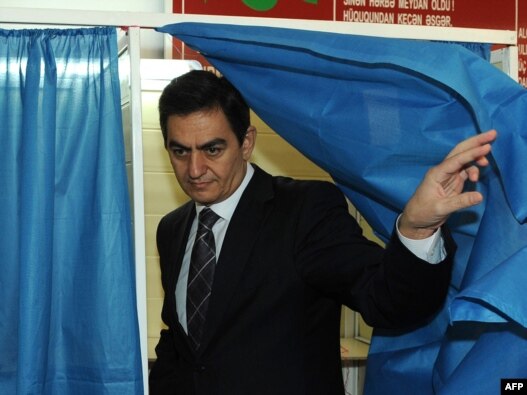
Ali Kerimli, leader of the opposition Azerbaijani Popular Front, leaves a voting booth in Baku.
by Ryan Weber

On November 7, the people of Azerbaijan went to the polls to elect a new class of legislators for the 125-seat Milli Majlis parliament. The voting was conducted in a peaceful environment, and representatives from all major opposition parties were included on the ballots. The number of women representatives in Parliament rose from 12 to 16. This is the "good news," presented by such rose-tinged media outlets as PressTV, taken without context from the OSCE/ODHIR Preliminary Report issued on November 8.

But, of course, it leaves out a few key details, like credible reports of voter fraud, administrative bias, and manipulated vote tabulations, all occurring within a campaign reduced to just 1/3 its previous length, devoid of public debate, and with minimal signs of public engagement or political contestation.

The unedited OSCE executive summary reads as follows:
"While the November 7, 2010 parliamentary elections in the Republic of Azerbaijan were characterized by a peaceful atmosphere and all opposition parties participated in the political process, the conduct of these elections overall was not sufficient to constitute meaningful progress in the democratic development of the country.

Overall, the Central Election Commission (CEC) administered the technical aspects of the electoral process well. However, limitations of media freedom and the freedom of assembly and a deficient candidate registration process further weakened the opposition and made a vibrant political discourse almost impossible." (read the full OSCE 2010 report)
Put more bluntly, there may have been an election, but it was not an exercise in democracy. And despite the efforts of the OSCE and other election observer missions to address the subject delicately, we must admit that while there can be greater and lesser degrees of progress toward democratic processes, the greater question of whether a system of governance is or is not democratic is one of type, not degrees.

Thursday, November 4, 2010

Kyrgyz Voter Lists: Do Unusual Figures Suggest Fraud, or First Honest Results?

by Ryan Weber

In Spring 2005, the government of President Askar Akayev conducted scheduled elections for the bi-cameral Kyrgyz Parliament. The results, and the process that attained them, were widely criticized, and by April 4 Akayev resigned after fleeing Bishkek to the Kyrgyz consulate in Moscow.

Akayev's fall was based on long-simmering accusations of corruption as well as his restrictions on political freedoms - especially in the electoral process. Four months after Akayev fled Bishkek, the Kyrgyz people went back to the ballot box, this time to elect his successor. Almost 2 million citizens cast votes - a 74.67% turnout - in what was regarded by international observers as "tangible progress" toward "international standards for democratic elections." (OSCE/ODHIR, 2005)

Five years later, after the hero of the "Tulip Revolution" was himself overthrown for nepotism and authoritarian tendencies, the Kyrgyz again went to the polls, this time to indirectly elect a new chief executive - the Prime Minister. Initial reports were even more positive, despite pointing out the "urgent need for profound electoral legal reform" (OSCE/ODHIR, 2010) The 2010 Parliamentary election also set new records - the largest number of registered voters (over 3 million), and the lowest turnout in the country's history (55%).

The ramifications of this turn of events have been felt across the small country, as new electoral laws have caused for the first time the discrepancy between registered voters and ballots cast to influence the formation of government, as discussed earlier. Many, especially the Butun Kyrgyzstan party that was denied seats in Parliament as a result, have questioned the sudden addition of over 200,000 registered voters within the last month of the campaign. Such occurrences are not without precedent in Kyrgyzstan; both 2005 and 2009 saw approximately the same % increase in registered voters, but this was often attributed by international observers to administrative fraud, such as when the Bakiev regime approved exactly 114,000 new registrations from citizens living abroad - mostly in Russia - shortly before the 2009 vote.

Wednesday, October 27, 2010

Enthusiam Gap: How registered voter lists can marginalize small parties in the Kyrgyz Electoral System

by Ryan Weber

Following up on our earlier post about Kyrgyz Election Threshold Policy, numerous sources are citing the use of eligible voter lists, rather than actual ballots cast, as a highly unusual method of determining threshold results. One reason is the highly suspect nature of national registered voter lists, with common types of fraud including the registration of the deceased, minors, non-citizens, and even multiple registration.

In highly-efficient election systems, there are a number of bureacratic means to verify and double-check these registrations, combing through lists for repeats and cross-checking with tax records, etc. When all else fails, the system is protected to at least a slight degree by the difficulty of carrying this type of voter fraud into action. Multiple voting only works with the collusion of elections officials, and getting significant numbers of minors - much less the dead - to vote without arousing suspicion is also problematic.

According to the current Kyrgyz Electoral Code, election results are based on "votes of voters, included into voter lists, in the whole republic." (Article 77, subsection 2)

Interestingly, at least in its English translation, this sentence could grammatically infer two entirely different interpretations.
  1. "Based on votes of [actual] voters, [each of whom must be] included in voter lists"
  2. "Based on votes of [all potential] voters, [being any] included into voter lists"
In the case of the first example, the threshold should be calculated by its actual % of votes cast, as in most parliamentary systems. In the second, the unorthodox practice of applying threshold % based on non-voters becomes operative.

The previous post demonstrated the ramifications of this discrepancy.

But what about the voter lists themselves?

Thursday, October 21, 2010

By the Numbers: The Kyrgyz Parliamentary Election and its Quantitative Shortcomings

by Ryan Weber

As widely reported (including on this blog), the October 2010 Parliamentary elections in the Kyrgyz Republic were a tremendous accomplishment and a great step forward for the Central Asian state twice-"liberated" from semi-authoritarianism. The mere logistics of organizing an election in an often difficult-to-access country, with a weak central government, a history of rigged voting, and few experienced administrators were daunting. Doing so in the aftermath of an irregular regime change, under the guidance of a President still looking for legitimacy, and with simmering ethnic tensions following outbreaks of tremendous violence, is nothing to scoff at.

Or, as the opening paragraph of the OSCE/ODIHR preliminary report puts it, "The 10 October parliamentary elections were conducted in a peaceful manner. The authorities displayed the political will to bring the Kyrgyz Republic closer to holding democratic elections in line with OSCE commitments. Political pluralism, a vibrant campaign and confidence in the Central Commission for Elections and Referenda (CEC) characterized these elections. Fundamental freedoms, including the freedoms of expression, assembly and association, were generally respected. Overall, these elections constituted a further consolidation of the democratic process. Nevertheless, there is an urgent need for profound electoral legal reform."

However, handing the Kyrgyz effort a blank check of congratulations ignores some of the less laudable aspects of the process, and obscures the areas in which the government, even the newly-adopted Constitution itself, is working against its own stated objectives. Take, for instance, the question of electoral thresholds.

Nothing puts non-experts into a catatonic stupor like discussing electoral technicalities, but in the case of the 2010 Kyrgyz Parliamentary elections, the numbers clearly demonstrate how one aspect of electoral policy can influence not only the makeup of the resulting government, but the ultimate distribution of power and future trajectory of the entire country. Additionally, electoral thresholds tell us a lot about the intended inclusiveness of the resulting government - that is, how many different voices are allowed to play a role in national decisions. Thresholds are employed in many parliamentary systems as a way to make governing more effective - removing marginal parties and encouraging compromise and coalition building - but have the notorious potential of going too far. When a threshold is set too high, or other factors are used to intentionally disenfranchise specific groups, this is recognized as an abuse of thresholds and contradictory to the productive democracy they ostensibly support.

I contend that the Kyrgyz elections, which employed a 5% threshold of eligible voters and a 0.5% "regional threshold," represent a poor implementation of the principle. Below I present figures demonstrating how different threshold policies would have resulted in different governing results and levels of inclusion for the 120-member Kyrgyz Parliament as it moves forward.

Tuesday, October 12, 2010

Cautiously Optimistic: Kyrgyz Election Marks Progress, But Challenges & Concerns Remain

by Ryan Weber

On October 10, 2010, the people of the small Central Asian Kyrgyz Republic overcame considerable social, administrative, and historical hurdles to emerge as the region's most politically competitive country, and its first to entrust executive power to parliament. Both accomplishments are laudable, rebuking the dominant trends of this semi-authoritarian presidential region, though many uncomfortable conditions continue to surround the weak government of President Rosa Otunbayeva. The extra-legal method by which former President Kurmanbek Bakiev was ousted in April - alternately described as a coup, revolt, revolution, riot, or collapse - followed in June by ethnic violence against Kyrgyz citizens of Uzbek identity, aided and abetted by members of the Kyrgyz military, hardly inspire confidence in the fledgling regime.

In addition to these high profile disturbances, the post-Bakiev Kyrgyzstan has struggled to live up to the pro-democracy ideals professed by its interim government. Questions of press freedom, over-zealous state prosecutions of Bakiev-era politicians and business leaders, and continuing rifts along regional North-South and various ethnic divisions haunt the prospect of a free and equal society. The fervent opposition has become the ruling elite, only to face new demands and challenges from both dispossessed Bakiev supporters and former colleagues in Human Rights advocacy NGOs.

It is not an easy situation, with lingering international pressure between Russia and the United States in the balance, and a strong Chinese influence still waiting to throw its weight behind any particular group.