Showing posts with label Babanov. Show all posts

Friday, December 17, 2010

Take Two: Kyrgyzstan Finally Has New Government

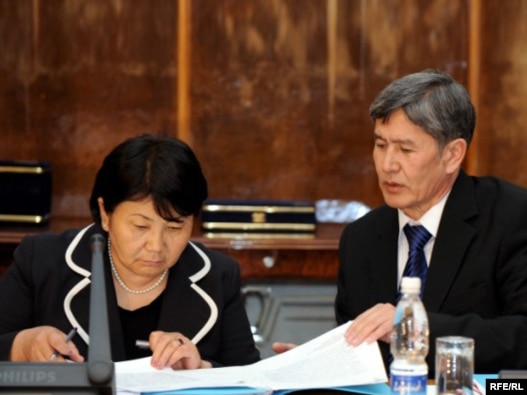
Newly-elected Kyrgyz Prime Minister Almazbek Atambaev (at center) joined by Omurbek Babanov (sans tie) and other members of the successful majority coalition that finally gave Kyrgyzstan a functional government on December 17. (photo credit S. Dosalieva, AKI Press)

Three of Kyrgyzstan’s quarreling parties have finally succeeded – after two months and one failed attempt – to form a government. The partnership may seem an unlikely one, but it unifies the country’s fractious north and southand all hopes are on this group to shepherd the country safely into a new year without political instability and violence.
Parliament convened on December 17 to approve the coalition proposed by Respublika leader Omurbek Babanov. Provisional President Roza Otunbayeva chose Babanov to lead the process on December 4, after the first attempt by her Social Democratic Party’s (SDPK) Almazbek Atambayev, fell through.

This coalition looks much like the first, botched one, with a stark exception. In place of the pro-Otunbayeva Ata-Meken party, it includes the nationalist Ata-Jurt party, whose Myktybek Abdyldayev will take the speaker position; Atambayev has assumed the premiership. Together with Respublika, the coalition holds 77 of the legislature’s 120 seats, a comfortable majority.

Monday, December 13, 2010

Waiting for Parliament and a Kyrgyz Santa Claus

by Ryan Weber

For those of us anxiously waiting to see what sort of governing coalition will emerge from the Kyrgyz parliamentary negotiations, it's beginning to feel more and more like we may be waiting for a 'Godot' - the fictional character in Samuel Beckett's drama who, (in)famously, never arrives. Or perhaps, with the December 24 deadline for the formation of the next parliamentary coalition, it's up to the equally-fictional Santa Claus to finally bring resolution to the Kyrgyz political situation.

After requiring the full 15 working day period allowed by the constitution, the SDPK-Respublika-AtaMeken coalition failed to elect Omurbek Tekebaev as Speaker of Parliament on December 2. Since the coalition agreement was based on the awarding of the Speaker position to Tekebaev, as well as the Prime Ministership to SDPK leader Almazbek Atambaev, and Deputy PM to Respublika's Omurbek Babanov, the coalition couldn't enforce its contract, and thus dissolved. With 67 nominal coalition members in the 120-seat legislature, the surprising defeat with just 58 votes for Tekebaev demonstrated the practical, as well as theoretical, shortcomings of the agreement. Just days after signing a pact of solidarity, coalition members voted against their own coalition.

On December 3, an embarrassed Atambaev asked Kyrgyz President Roza Otunbayeva to select another party to form the coalition. Originally, Otunbayeva said Ata-Meken, as the other "pro-government" party, would be tasked with the duty if SDPK failed. Instead, whether because Tekebaev declined the opportunity, or Otunbayeva reacted to his apparent unpopularity, Omurbek Babanov and Respublika were given the charge along with a new deadline - December 24.

With the race to form a coalition once again wide open - with rumors that perhaps 4, or even all 5 political parties will join together - the possible make up of the ruling Kyrgyz government remains an item of intense, if largely uninformed, speculation.

Monday, December 6, 2010

If at First you Don't Succeed: Kyrgyz Parliament Takes Another Shot at Forming Majority Coalition

by Ryan Weber

The march of Kyrgyzstan's fledgling parliamentary democracy took another hit on December 4 as the recently-announced "Coalition for the Sake of Stability" turned out to be a "Stillborn Coalition" as it failed to achieve its first test of forming a parliamentary government.

Despite its 3 parties controlling 67 delegates - a majority of the 120-seat Jogorku Kenesh parliament - it was only able to muster 58 votes in support of its candidate for Speaker of Parliament. That candidate, the leader of the Ata-Meken party and a former Speaker of Parliament, Omurbek Tekebaev (pictured below right), failed to receive the necessary 61 votes because 9 coalition MPs (identities unknown) didn't vote for him.

Tekebaev has been out of government positions since 2006, but remains a major player in Kyrgyz politics as a former opposition activist, interim deputy chaiman, and architect of the new Kyrgyz Constitution adopted in July. With the possible exception of President Roza Otunbayeva, he is the individual most responsible for adoption of the strong parliamentary system under which Kyrgyzstan is struggling to operate.

Wednesday, December 1, 2010

Kyrgyz Parliament Sets Majority Coalition

The Kyrgyz Parliament in their first (and so far, only) session on November 10. With the formation of a majority coalition on November 30, parliament is expected to begin regular meetings soon. (photo credit AFP)

by Ryan Weber

As reported earlier (Nov. 24 and Nov. 29), the Kyrgyz Parliament has been deadlocked since its opening session on November 10 because no single party, or even group of two parties, controls enough seats to form a majority of the 120-member Jogorku Kenesh Parliament and name a Prime Minister, as required by the Constitution.

On November 30, just 2 days before the deadline set by President Roza Otunbayeva, that deadlock has finally been broken. After weeks of intense negotiations, including meetings with the rival Ata-Jurt and Ar-Namys parties, the SDPK party revealed an agreement with longtime fellow "pro-government" socialist party Ata-Meken and the new business-oriented party, Respublika.

This was the exact coalition that analysts expected to emerge following the October 10 elections, but breakdowns in the negotiations, accusations of international bias, and stubborn party leaders caused the "obvious" coalition to stall time and time again. Just November 29, Farid Niyazov, spokesman for the SDPK party, said that the two most likely coalition outcomes would include the Ata-Jurt party, which controls 28 seats in parliament, the most of any party.

But on November 30, an agreement was signed - without Ata-Jurt.


Monday, November 29, 2010

Kyrgyz Horse-Trading: Negotiations Continue in Parliament Coalition Building

Kyrgyz President Roza Otunbayeva and SDPK leader and presumptive Prime Minister, Almazbek Atambayev. Otunbayeva appointed Atambayev to form a majority coalition in parliament, but SDPK has struggled to deliver as the deadline nears. (photo credit RFE/RL)

by Ryan Weber

Negotiations to form a majority coalition in the Kyrgyz Parliament continue despite the passing of the November 27 deadline issued by President Roza Otunbayeva on November 11. At that time, she gave the Social Democrat party (SDPK) 15 days to assemble a functional coalition among the 5 parties represented in parliament. She also issued the stipulation that if they could not reach such an agreement, coalition-building power would transfer to the minority Ata-Meken party.

Depending on how one counts, that put the deadline at either November 27 (if 15 calendar days), or December 2 (if 15 working days). As the horse-trading heated up last week, SDPK party spokesman Farid Niyazov announced repeatedly that SDPK would be unveiling its coalition by November 30... then December 1... then December 3.

The Respublika party is a known coalition partner of SDPK, but together the two parties only control 49 seats in parliament, 11 short of the majority. The talks, which initially focused on the Ata-Meken party, have since expanded to include meetings with Ata-Jurt and Ar-Namys, leaving the possibility of a previously inconceivable cohort.

Rumors abounded late last week about the possibility of Ar-Namys leader Felix Kulov as the Attorney General, or Ata-Jurt's Kamchybek Tashiev as a deputy Prime Minister. Ar-Namys, the least likely candidate for partnership, reportedly snubbed these overtures, demanding the Prime Ministership as a condition for its participation in the majority.

Apparently, SDPK leader Almazbek Atambayev continued his furious pace of multi-party negotiations over the weekend, and has emerged on Monday (Nov 29) with what appeared initially as the most likely conglomeration - SDPK, Respublika, Ata-Meken.

The news comes less than a day after Niyazov told News Agency 24.kg that "the most possible variants of the parliament coalition in Kyrgyzstan are SDPK-Respublika-Ata-Jurt or SDPK - Ata-Meken, Ata-Jurt."

Instead, later that same day a draft agreement surfaced in which SDPK would award the PM to its own leader, Atambaev, while Ata-Meken leader Omurbek Tekebaev would become Deputy PM, and Respublika's Omurbek Babanov would be the Speaker of Parliament.

Until parliament meets again, the exact nature of the coalition is likely to remain uncertain. Ata-Jurt's willingness to consider working alongside its perceived nemeses SDPK and Ata-Meken is encouraging, as has been Respublika's role as a moderating, economic-focused influence between the progressive "pro-government" and "old guard" factions.

Wednesday, November 24, 2010

The Great (Guessing) Game: Imagining the Unlikely Kyrgyz Parliamentary Coalition

Almazbek Atambaev and Omurbek Tekebaev, shown here during the 2009 Presidential election when both were protesting incumbent Kurmanbek Bakiev's victory.  The two now face a new challenge trying to form a coalition government between their SDPK and Ata-Meken parties. (photo from AKIpress)PHOTO: Almazbek Atambaev and Omurbek Tekebaev, shown here during the 2009 Presidential election when both were protesting incumbent Kurmanbek Bakiev's victory. The two now face a new challenge trying to form a coalition government between their SDPK and Ata-Meken parties. (courtesy AKIpress)

by Ryan Weber

Since the Kyrgyz CEC announced its official vote tally, and the resulting number of seats awarded to each of the 5 parties, on November 10, politicians and analysts have been predicting what the eventual ruling coalition would look like. Initial speculation that the pro-government Social Democrats (SDPK) would caucasus with Ata-Meken to form a majority were premature; even together the two parties don't control the 60 seats required to hold majority, and divisions and delays have continued to plague negotiations.

Instead, almost out-of-the-gate, SDPK announced a coalition with the new Respublika party, and began working to secure Ata-Meken as the third and final component. But this too has failed to materialize, and with the November 27 deadline issued by President Roza Otunbayeva just days away, Kyrgyz political calculus is headed rapidly into the realm of advanced theoretical mathematics. Ata-Meken, as the smallest party in Parliament with just 18 seats, would clearly benefit from joining the coalition, if not for the fact that if SDPK's efforts fail, Otunbayeva will next turn to Ata-Meken to lead the formation of government.

Ata-Jurt and Ar-Namys, both of whom swept into Parliament on much higher-than-expected results, were initially quite upset at winning a plurality of votes, only to wind up in the parliamentary opposition. But the failure of a "pro-government" bloc to materialize gives both an opening to gain influence by working with their former opponents.