Showing posts with label Azerbaijan. Show all posts

Monday, August 22, 2011

Modern Maginot - Central Asian Oil Pipelines May be Obsolete Before They Pay Off Time, Cost of Construction.

article originally posted on CA-NEWS.org


Central Asia is quickly emerging as a global center of hydrocarbon production, but the ambitious transnational pipelines built to access this oil and natural gas wealth may become obsolete sooner than anticipated.

Since at least the 17th century, the Caspian basin supplied hydrocarbons of one form or another to markets in Europe, the Middle East and Central Asia. Naphtha, kerosene, mazout, petroleum, and now natural gas have all brought international interest and wealth to the otherwise economically underdeveloped region. Local entrepreneurs and foreign investors have made - and lost - fortunes as political, economic and technological changes either emanated from, or swept over, the region.

Today, Azerbaijan, Turkmenistan, Kazakhstan, and Uzbekistan produce substantial amounts of oil and natural gas, and stand to become major hydrocarbon exporters to a global market of increasing demand. This is true for both emerging economies like China and India, as well as energy-intensive developed countries in Europe. The challenge facing modern multi-national corporations and national petrol companies is the same - how to dispose of the region's resource wealth profitably. The best answer to date is to transport these gaseous and liquefied goods to the markets of greatest demand, China and Europe, via long-distance transnational pipelines.

Tuesday, November 23, 2010

A Hard Look in the Mirror: Central Asia Scores Poorly on Perception of Corruption


by Ryan Weber

Transparency International Released its 2010 Corruption Perception Index (CPI), and as the regional map shows (above), Central Asia is left looking rather red in the face. On a scale of 0 to 10, in which lower numbers were judged more corrupt by respondents, the regional regimes scored between 2.9 (Kazakhstan) and 1.6 (Uzbekistan & Turkmenistan). Georgia, China and Russia provide some context, with the first two - by no means poster children for anti-corruption - scoring higher than any Central Asian states at 3.8 and 3.5 respectively, while Russia, the dominant political force in the region, held steady with the pack at an embarrassingly low score of 2.1.

The Index, which is compiled from a series of surveys filled out by citizens of each country then averaged and adjusted according to the survey biases, is just one measure, and an admittedly imperfect one, to evaluate the level of corruption active in the everyday, as well as institutional levels of government. Corruption is a difficult concept to define, ranging from police traffic bribes to no-bid government contracting, and even more complicated to track accurately. The index provides a "rough barometer" of public perceptions, captured at the moment they take a survey, and not held against a baseline experience. As such, as the Transparency International website warns,
"The CPI is not a tool that is suitable for trend analysis or for monitoring changes in the perceived levels of corruption over time... Year-to-year changes in a country’s score can result from a change in the perceptions of a country’s performance, or changes in the methodology resulting from TI’s efforts to improve the index." (link)
Well and good, but trend analysis may in fact provide some interesting results when considered in light of the events affecting the various countries, or as a measure of the similar or dissimilar year-by-year corruption perception of citizens from different countries within a shared region. It must still be stressed, what such analysis will show is not the level of corruption in any country, but the perception of corruption among its citizens.

Monday, November 8, 2010

Azerbaijan Elections: Pseudo-Democracy as an All-Too-Familiar Mask

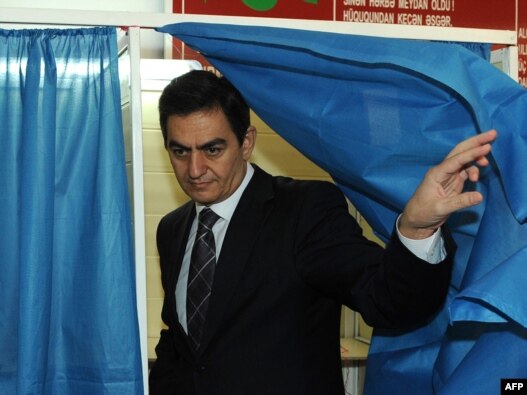
Ali Kerimli, leader of the opposition Azerbaijani Popular Front, leaves a voting booth in Baku.
by Ryan Weber

On November 7, the people of Azerbaijan went to the polls to elect a new class of legislators for the 125-seat Milli Majlis parliament. The voting was conducted in a peaceful environment, and representatives from all major opposition parties were included on the ballots. The number of women representatives in Parliament rose from 12 to 16. This is the "good news," presented by such rose-tinged media outlets as PressTV, taken without context from the OSCE/ODHIR Preliminary Report issued on November 8.

But, of course, it leaves out a few key details, like credible reports of voter fraud, administrative bias, and manipulated vote tabulations, all occurring within a campaign reduced to just 1/3 its previous length, devoid of public debate, and with minimal signs of public engagement or political contestation.

The unedited OSCE executive summary reads as follows:
"While the November 7, 2010 parliamentary elections in the Republic of Azerbaijan were characterized by a peaceful atmosphere and all opposition parties participated in the political process, the conduct of these elections overall was not sufficient to constitute meaningful progress in the democratic development of the country.

Overall, the Central Election Commission (CEC) administered the technical aspects of the electoral process well. However, limitations of media freedom and the freedom of assembly and a deficient candidate registration process further weakened the opposition and made a vibrant political discourse almost impossible." (read the full OSCE 2010 report)
Put more bluntly, there may have been an election, but it was not an exercise in democracy. And despite the efforts of the OSCE and other election observer missions to address the subject delicately, we must admit that while there can be greater and lesser degrees of progress toward democratic processes, the greater question of whether a system of governance is or is not democratic is one of type, not degrees.